Equinor
Energy
Leveraging design thinking to build a powerful strategy
Outcome
A report that establishes a common vision of future on-site collaboration, outlines current issues, opportunities for improvement and pilot projects to be developed over 10 years, in order to unify the strategy of Equinor’s different departments and lead them to a digital and structural transformation.
"You have easily managed to communicate the changes needed to be done. The positive response we got in the taskforce meeting from the different members was something you do not often experience. Throughout this project you have really shown the value of design thinking."
Client manager
"I have really enjoyed working with you guys and seeing how you have transformed our input into a conceivable concept that we can communicate in a structured way. I look forward to working with you again and I expect it to happen in the near future."
Taskforce member
Challenge
After Covid-19, Equinor, the Norwegian energy leader, faced several issues that impacted the safety and efficiency of its employees:
the various onshore and offshore sites work together without any real connection or understanding of each other's issues
each department has a fragmented view of the data in the system
there are too many different, non-standardised technological solutions used for communication
My contribution
I helped a taskforce of 15 key stakeholders to co-create and align on a common strategy.
I started by identifying and mapping their roles, goals and pain points through phases of user research, and then facilitated brainstorming and co-creation workshops.
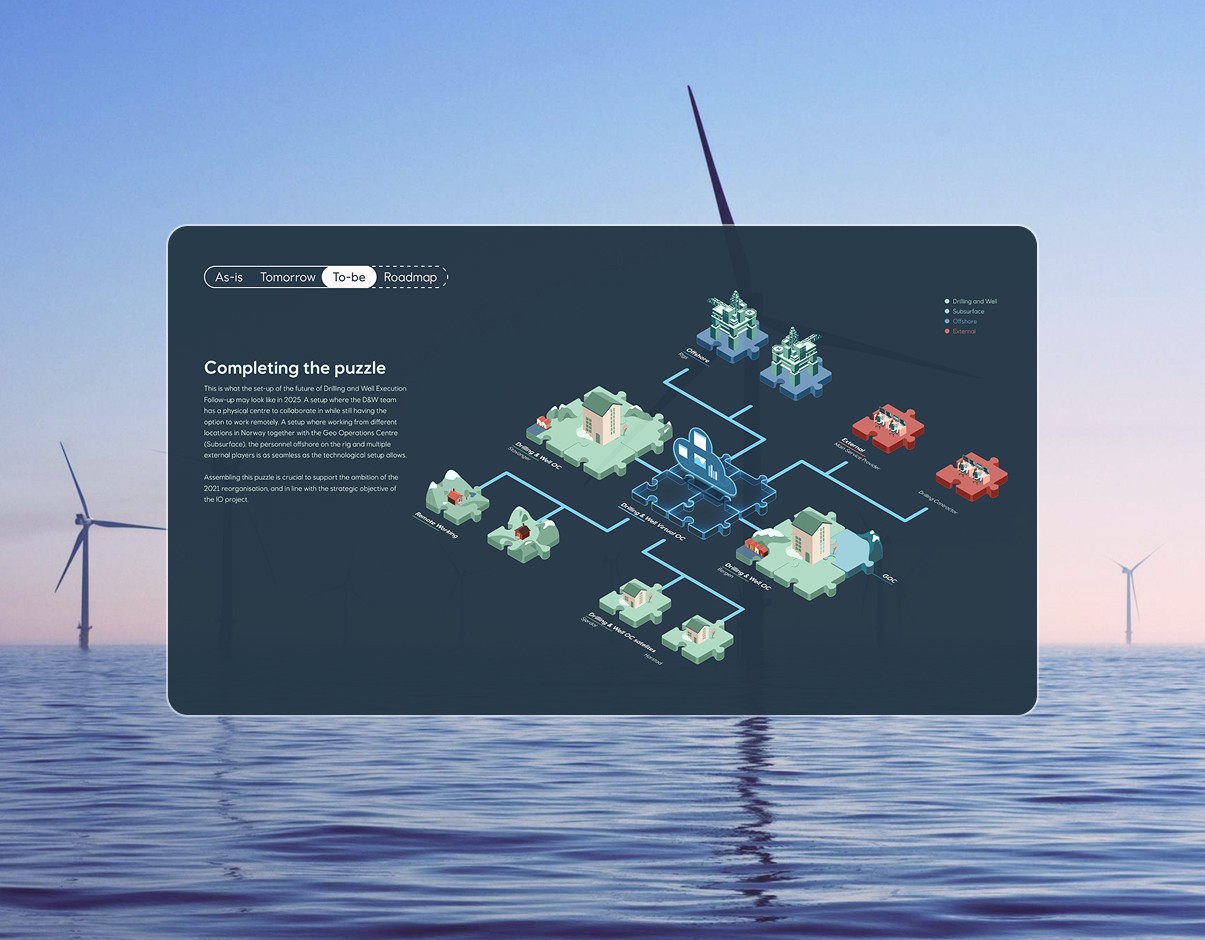
Finally, I build an interactive and visual presentation in Figma summarizing the key lessons we learned and outlining the main steps of an action plan to be implemented over 2, 5, and 10 years.
Key decisions
1) I facilitated collaboration and alignment among stakeholders around a common strategy
Teaming up with a Strategist Designer, I imagined and facilitating a series of workshops and user interviews over a period of 6 months with 15 stakeholders from 3 different departments to:
map existing processes
identify pain points and future challenges
align ideas for improvement
co-create a unified vision for a 10-year solution
It was a real change for these engineers, not used to collaborating across departments, to be able to take part in a holistic transformation of their company through a Design Thinking approach.


2) I turned this strategy into an interactive presentation designed for decision-making and to obtain approval from its management
Once the strategy had been finalised, I turned it into a three-part action plan (the current situation, the near future and the 2030 horizon), structured around powerful visual concepts to make it accessible to everyone.
Each part is a system that details the relationships between employees and their external partners, their ways of working, the technological solutions used and illustrates the impact of the transformation on three levels: organisational, technical and human.